


TL;DR
For most US utility contractors, hydraulic power tools are the right default in the truck. Gas still wins remote, open-air jobs where there's no power source nearby. Electric covers drilling and finish tasks. Air stays in the shop. The rest of this post shows how we got there, and where your work fits in.
What Pro Utility Tool is Best?
Every utility crew leaves the yard in the morning carrying power tools that run on one of four things. Gas, electricity, compressed air, or hydraulic oil. Most of the time, you inherit whatever the last generation of your company used, and the question of whether there's something better never really comes up.
We think it should. At HYCON, we build handheld hydraulic power tools for US utility contractors, and we've watched the default shift over the last decade.
The contractors we work with spend real money on tools every year, and they carry those tools on their shoulders for eight to ten hours a day. A wrong power source means more pulls on a cold cord, more trips to the shop for carburetor work, more crew standing around waiting on a battery, or more money spent on fuel that didn't need to be burned.
This piece puts the four power sources side by side and scores them on the things that matter when you're in the hole, not in the catalog. By the end, you'll have a clear sense of which power source belongs in your truck as the default, and which ones still earn a spot in the kit for specific jobs.
One power source does not win everything, but one has quietly moved from specialist to default across the utility segment, and we'll show you why.
How We Compared Them
We scored each power source on six things, the same six you'd think about if you were buying tools today.
- Power to weight ratio. What you actually get in the cut, per pound of tool you're holding.
- Reliability in real conditions. Wet trenches, cold mornings, dusty ditches.
- Safety, for the operator and the crew nearby.
- Total cost to own. Purchase price, fuel, maintenance, and the downtime nobody puts in the brochure.
- Portability and setup time. How fast the tool is producing work after the truck doors open.
- Regulations. Emissions rules indoors, confined-space limits, local bans.
If a category has a weakness, we say so, even about hydraulic, which is our specialty.
Quick-Look Comparison
Before we go deep, here's the shape of the answer.
Criteria |
Gas |
Electric |
Air |
Hydraulic |
|---|---|---|---|---|
| Power to weight | Fair | Fair | Good | Excellent |
| Wet and cold | Poor | Poor | Fair | Excellent |
| Indoor and confined | Poor | Good | Good | Good |
| Portability | Good | Good | Poor | Medium |
| Setup time on-site | Fast | Fast | Slow | Medium |
| Fuel and maintenance cost | High | High | Medium | Low |
| Works for most utility tool types | Yes | No | No | Yes |
Gas-Powered Tools, The Incumbent
Gas-powered tools carry a two-stroke engine on the tool itself, running on a fuel mix and delivering cutting or breaking power anywhere you can carry a fuel can.
Gas has been the default on most utility crews for decades, and it's easy to see why. You fill the tank, pull the cord, and you're cutting. No power pack, no compressor, no outlet.
Where gas still earns its keep is remote, open-air work. If you're out on a rural right-of-way, a mile from the truck, with no power source nearby, a gas saw or breaker is hard to beat for sheer simplicity.
Where gas falls down is everywhere else. Emissions rules are tightening on indoor demolition and confined-space work, and that trend is one-way. The pull-start gets harder in the cold. Carburetors need attention, plugs need cleaning, and a two-stroke that sat over a long weekend is a coin flip on whether it fires first thing Monday.
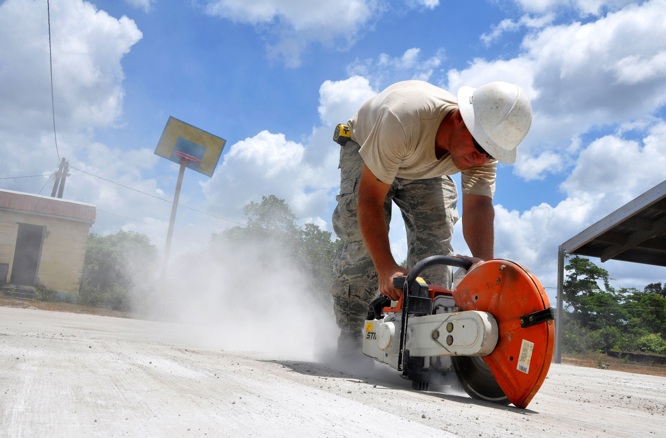
Then there's the weight. A gas cutoff saw carries the whole motor on the tool. That's twelve to fifteen pounds on your shoulder all day, and the folks doing this work aren't twenty-five anymore. We hear the same thing from contractors in their fifties, the shoulder gives before the tool does.
Best for rural open-air work where there's no power source nearby and no emissions restrictions. Decent backup kit for crews that mostly run on other power sources.
Skip it if you do indoor work, confined-space work, or wet utility. Gas is wrong for those jobs, and the jobs know it.
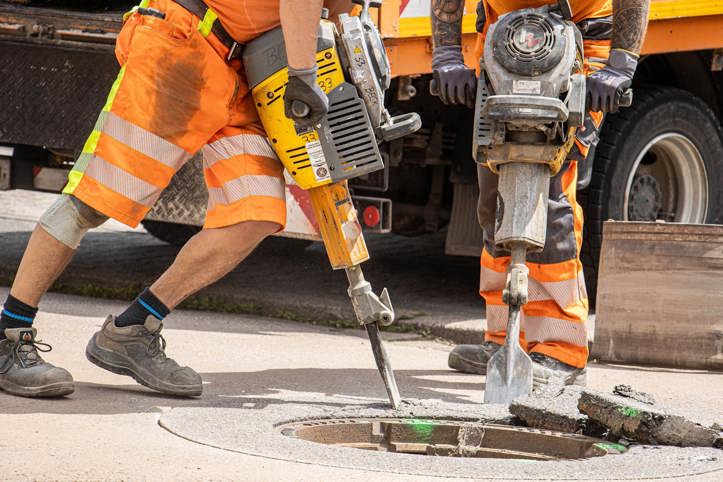
Electric Tools, Corded and Battery
Electric power tools run on either a wall outlet or a rechargeable battery pack, with the motor built into the tool and no fuel source attached.
Electric splits into two different stories, and you have to look at them separately.
Corded electric gives you steady, predictable power as long as you're near an outlet. Drills, grinders, and demo hammers on a corded platform run all day without fuel, without fumes, and without a pull cord. The ceiling is physical, you're tied to the wall. On a utility jobsite, the wall is often a hundred feet away.
Battery electric has closed that gap on lighter tools. For drills, impact drivers, and small grinders, modern battery platforms are genuinely good. The problem shows up on the heavy end. A battery cutoff saw running through ductile pipe hits thermal cutoff faster than you'd expect, and you're swapping packs every fifteen to twenty minutes. And runtime math matters on a jobsite. If two guys are waiting while batteries charge, that's a line item you should be tracking.
Battery tools also fade under load. The first minute of a cut feels strong, the third minute feels weaker, and by the fifth minute you're wondering if it's you or the tool.
The cost story on electric isn't as clean as people assume either. High-output battery packs carry real price tags, chargers and charging infrastructure add up, and the packs themselves wear out in three to five years of heavy duty. Corded cuts some of that out, though you're still replacing brushes and motors on the heavy tools.
Best for finish work, drilling, light demolition, anything where you're near a wall outlet or you can tolerate short runs. Great secondary power source for any utility crew.
Skip it if you're cutting cast iron pipe, breaking concrete in a trench all day, or working in water.
Pneumatic Tools, The Old Workhorse
Pneumatic tools run on compressed air delivered from a dedicated compressor through a hose, with the tool itself holding a simple turbine or piston and no motor of its own.
Air tools have a reputation for being bulletproof, and it's earned. An air hammer or air saw is simple, there's not much to go wrong, and a properly maintained unit will outlast two sets of gas tools.
The catch is the compressor. Compressors are loud, fuel-hungry, and they tie your crew to a trailer. The air hose limits your working radius, and dragging a hundred feet of line into a trench is no one's idea of a good time.
Cold weather causes problems too. Moisture in the line freezes, power output drops, and you're stopping to drain lines instead of working.
Power density per pound of tool is solid. Air tools are often lighter than their gas equivalents because, like hydraulic, the motor isn't on the tool. The tool itself also runs clean indoors, no exhaust at the point of work, which is why air keeps a seat at the table for basement and vault jobs where the compressor can sit outside.
Still, the system cost and the mobility penalty add up fast on a mobile utility crew.
Best for fixed-position shop work, industrial settings where a compressor is already running, and specific tasks where an air tool is genuinely the best option.
Skip it if you're running a mobile crew that moves from site to site. The compressor drag isn't worth it.
Hydraulic Tools, The Dark Horse Moving Up
Hydraulic power tools run on pressurized oil fed from an external power pack, which means the motor lives off the tool and the tool itself carries only a small actuator.
Hydraulic is what we breathe at HYCON, so take this section with the grain of salt it deserves. But the reason we build here is the reason crews are switching, and the numbers don't care where our bias is.
The core design difference is simple. On a hydraulic tool, the motor lives on the power pack, not on the tool itself. You get the same cutting power as a gas saw, but the thing on your shoulder is lighter, more balanced, and about half the bulk. Contractors who've spent a decade with a gas saw notice it in the first five minutes.
Hydraulic runs in water. Underwater, even. That matters if you work in wet utility, storm systems, or any environment where the trench you're standing in has six inches of water at the bottom.
There's no spark, which means hydraulic is safe around gas lines and in confined spaces where a small ignition source would be a bad day for everyone. Emissions rules don't apply, since there's nothing being burned at the tool.
One power pack fuels everything. Cutoff saw, breaker, pump, drill, core drill. Your whole tool kit runs off one fuel source, one filter schedule, one piece of maintenance to track.
Honest downsides, because there are some. You need the power pack investment up front, and that's real money compared to buying one gas saw. The hoses require a discipline the crew has to learn, kinks and bad connections create headaches the first season. And if you do remote one-off work without a power pack, a gas saw is still faster to deploy for that one cut.
Best for wet utility, underground work, indoor demolition, confined-space work, and any crew that wants one power source feeding an entire tool kit.
Skip it if all your work is single-cut, single-site, rural, and open-air. Gas still wins that narrow slice.
Head-to-Head by Task
The theory is useful, but most contractors buy tools one task at a time. Here's how the four power sources stack up on the utility jobs that come up the most.
Cutting cast iron or ductile pipe
Hydraulic ring saw wins. The balance, the power at depth, and the ability to cut with water flowing in the trench decide it. Gas is a solid second for open-air cuts. Electric and air are out of their depth here.
Breaking concrete in a trench
Hydraulic breaker takes the top pick for confined and indoor work, mostly on weight per pound of delivered energy. Electric and air will both run indoors too, though electric fades on sustained breaking and air ties you to the compressor. Gas wins in open, remote demo where you don't care about fumes and you don't want to run a power pack.
Pumping a flooded excavation
Hydraulic pump wins, cleanly. It's the only option that lets you run the pump off the same power pack that's running your saw and your breaker, which means you're not dragging a second gas unit into the trench. Electric submersible is a distant second if an outlet is available.
Drilling through a utility vault wall
Depends on thickness. For walls under six inches, corded electric or battery is fine. For anything thicker, hydraulic core drills are worth the setup. Gas is rarely the right answer for drilling.
The pattern across four tasks is clear. Hydraulic is the default for the bulk of utility work, gas holds one specific lane, electric is the right tool for finish work, and air is a specialty option.
Our Pick for Most Utility Contractors
If you run a crew that spends most days in wet utility, underground, storm, or indoor utility work, hydraulic earns the default slot in the truck. That's where the jobs are getting harder, the regulations are getting tighter, and the power pack pays back the investment in fuel savings, fewer tools to service, and less weight on the crew.
Keep a gas saw in the kit for the one type of job where it still wins. Remote, open-air, single-cut work with no power pack in reach. That job comes up often enough that gas isn't going anywhere in the kit, though it isn't the default slot either.
Electric earns a permanent spot for finish tasks and anywhere near an outlet. Drilling, light grinding, small demo. Battery platforms are good enough now that every utility crew should carry them.
Air stays in the shop. On a mobile utility crew, the compressor trail isn't worth the tool weight savings.
How to Choose for Your Crew
Three questions will get you ninety percent of the way to the right answer.
- How often are you jobs in wet or confined spaces in a typical month? If the answer is "often" hydraulic is your default and gas is your backup.
- How often does your crew swap between tool types in a single day? If the answer is "a lot," one power pack feeding all your tools is worth real money over a year.
- What's your fuel and maintenance budget look like? If carbs, plugs, and two-stroke mix are eating into a weekend every month, the total cost story tips hard toward hydraulic.
Run those three questions against your next ten jobs and the answer usually makes itself. Pick the power source that fits the work you actually do, not the one your old boss ran when you were coming up. The jobsite has changed. The right tool for it has changed too.
Frequently Asked Questions
Are hydraulic tools better than gas?
For most utility work, yes. Hydraulic tools are lighter per unit of cutting power, safer in wet and confined conditions, and cheaper to run over a full season. Gas still wins one specific lane, remote open-air work with no power pack nearby, so a smart utility crew keeps a gas saw for that job and runs hydraulic for everything else.
What are the downsides of hydraulic power tools?
Two real ones. You need a power pack up front, which is more expensive than a single gas saw. And the hoses need discipline, a crew that's new to hydraulic will kink lines and miss connections in the first season. Past that first year of habit building, the downsides mostly disappear.
Can you use hydraulic tools underwater?
Yes. Hydraulic tools run submerged without any change to their operation, because the working fluid is oil inside the tool, not air or spark. That's why hydraulic is the default for storm and wet utility work. A gas or electric tool in six inches of trench water is a failure, a hydraulic one keeps cutting.
How much does a hydraulic power pack cost?
Power packs are the main up-front investment separating hydraulic from a gas-first kit. Think of it not as a saw-versus-saw price tag but as infrastructure that runs every hydraulic tool you own. Where gas tools may have a lower purchase price, running the tool comes with an invisible cost: Idle time. The wait when the filters need changing. The extra break because of handling heavy equipment. The slower progress because of less power. And of cause, the extra tool break downs, because every tool carries it’s own engine.
What's the difference between a hydraulic and a gas cut-off saw?
The motor location. A gas cut-off saw carries its engine on the tool, which is why it's heavy on the shoulder. A hydraulic cut-off saw gets its power from a hose running to an external power pack, so the tool itself is lighter, more balanced, and safer in wet or confined work.
What power source is best for confined-space work?
Hydraulic or electric, depending on the task. Hydraulic leads on any heavy cutting or breaking in a confined space because there's no exhaust at the tool. Electric works fine for drilling and light work. Gas is wrong for confined-space operations in most jurisdictions now, and the trend is one-way as emissions rules tighten further.